Why your website is losing you enquiries (and how to fix it!)
Many local business websites look fine on the surface but fail to generate enquiries because they are unclear, thin on trust, hard to use, slow, or not visible enough in local search. Here is what to check and where to start.

In short
If your website is not generating enquiries, the most common reasons are vague copy, missing service pages, no trust signals, weak calls to action, slow loading, or poor visibility in search. Most of these are fixable without a full rebuild.
Your website is live. It looks fine.
The phone is not ringing because of it. The contact form is quiet. And while people may be finding your business somewhere, it does not feel like the website itself is doing much of the heavy lifting.
If that sounds familiar, you are not alone. It is one of the most common frustrations I hear from local business owners. Not "I do not have a website", but "I have one and it is not doing anything."
The good news is that most of the reasons a website fails to generate enquiries are fixable. They are usually not technical mysteries. They are straightforward problems with copy, structure, trust, speed, visibility or clarity.
Once those problems are identified, many can be improved without rebuilding the whole website from scratch.
This article walks through the most common reasons local business websites lose enquiries, and what to do about each one.
The website exists, but the job is not done
Having a website live is not the same as having a website that works.
A lot of local business websites were built to tick a box. Someone needed something online, so they put something online. It has the business name, a phone number, maybe a few photos, and a contact page.
That is a presence. It is not necessarily a sales tool.
For a website to generate enquiries consistently, it needs to do several things at once. It needs to explain clearly what the business does. It needs to make the right person feel like they have found what they were looking for. It needs to build enough trust that they feel comfortable getting in touch. And it needs to make the next step obvious and easy.
Most websites that are not converting enquiries are failing on at least one of those points, often more than one.
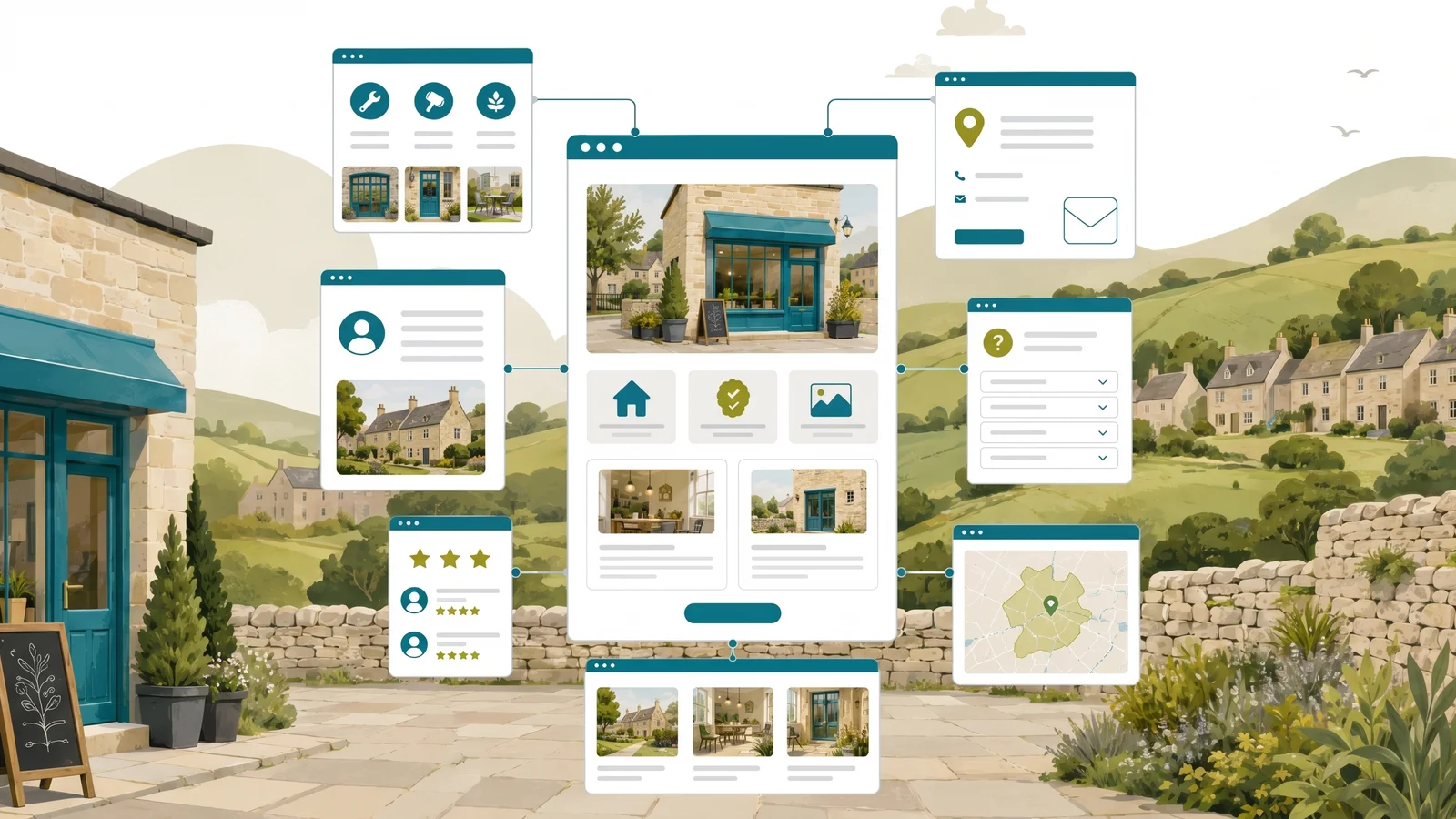
The most common reasons local websites lose enquiries
The homepage does not explain what you do quickly enough
Most visitors decide very quickly whether to stay on a page or leave.
If your homepage opens with a logo, a vague tagline, a stock photo of a handshake, or a line like "welcome to our website", you are already making people work too hard.
A homepage needs to answer three questions almost immediately:
- What does this business do?
- Who is it for?
- Where does it operate?
If a visitor cannot answer those three questions within the first few seconds, they will often leave rather than scroll down looking for clarity.
This matters whether you are a gardener, electrician, landscaper, dog groomer, local clinic, accountant, hair salon, barber, tradesperson or professional service provider. People do not want to decode your website. They want to know if you can help them.
The fix is straightforward. Lead with a clear headline that states what you do and who you help. Follow it with one or two sentences that add useful context. Make the next step obvious from the top of the page.
There are no clear service pages
A homepage that lists "Gardening, Landscaping, Fencing, Patios and Driveways" in a bullet list is not the same as having individual service pages.
Separate service pages matter for two reasons.
First, they give Google something specific to understand and index. A page titled "Garden design in Bristol" that explains what the service involves, who it is for, what is included and how to enquire has a far better chance of appearing in local search than a homepage that mentions garden design in passing.
Second, they give potential customers the information they need to make a decision. Someone who wants a new patio does not want to scan a general services list. They want a page that speaks directly to their situation, answers the questions they would normally ask on the phone, and makes it easy to get in touch.
If your website has no individual service pages, that is one of the most impactful things you can fix. For more on this, see what pages a local business website actually needs.
The copy is too vague to build trust
Read your own website copy as if you have never heard of the business.
Does it explain specifically what you do, or does it use phrases like "high-quality service", "competitive prices" and "fully professional"?
Those phrases do not mean anything on their own. Every business says them. They do not help someone decide whether to contact you over a competitor.
Specific copy builds trust. Vague copy erodes it.
Instead of this:
We provide a professional gardening service across the local area.
Try something more specific:
I look after private gardens in Bath and the surrounding villages, including regular maintenance, seasonal planting, lawn care and tidy-ups for people who want their garden to look good without having to do it themselves.
That is more words, but it is far more useful. It tells someone exactly what you do, who you help, and where you work. It also sounds like a real person wrote it.
There are no trust signals
A potential customer visiting your website for the first time knows very little about you.
They cannot tell from looking at a page whether you are reliable, experienced, reasonably priced, insured, qualified, responsive, or even still active.
That uncertainty creates hesitation. Hesitation means fewer enquiries.
Trust signals reduce that hesitation. They are the things on your website that help a visitor feel comfortable enough to take the next step.
Common trust signals include:
- Google reviews or testimonials, ideally with names and specific details
- Before and after photos of your work
- A brief, human "about" section that explains who you are and why you do what you do
- Accreditations, qualifications, insurance details or trade memberships where relevant
- A clear service area so people know you actually cover their location
- A named contact person rather than a faceless enquiry form
- Transparent information about how the process works
You do not need all of these. But if your website has none of them, visitors are being asked to trust a business they know nothing about, and many will not bother.
The calls to action are weak or missing
A call to action is the prompt that tells a visitor what to do next.
If your website does not have clear, visible calls to action, many visitors will simply read the page and leave. Not because they were not interested, but because nothing prompted them to take the next step.
Weak calls to action include things like "contact us" buried in a navigation menu, or a phone number in small text at the bottom of the page.
Stronger calls to action are visible, specific and low-friction. They appear multiple times on key pages, not just at the very bottom. They use plain language, such as:
- Ask about a quote
- Book a free visit
- Get in touch today
- Call me on...
- Send me a message
The principle is simple. Make it easy for someone who is interested to act on that interest immediately, without having to hunt for a way to get in touch.
The website is slow or broken on mobile
Most local searches happen on a phone.
If your website takes too long to load, a significant number of visitors will leave before they see anything. If it looks broken, cluttered or hard to navigate on a small screen, visitors will assume the business is not worth their time.
This is not just about design. Page speed and mobile usability can also influence how well a website performs in search, especially when users are bouncing before they have even seen the page.
You can check basic performance using Google's free PageSpeed Insights tool. If your scores are low, the most common culprits are large uncompressed images, unnecessary scripts, poor theme setup, plugin bloat, and hosting that is not optimised for fast delivery.
The website is not being found in the first place
Sometimes the enquiry problem is not on the page. It is before the page.
If nobody is finding your website, there is nothing to convert.
Local search visibility depends on a combination of factors. Your Google Business Profile needs to be verified, complete and regularly maintained. Your website needs clear service pages with relevant location references. Your business details need to be consistent across the web. You need reviews, and you need to be responding to them.
If you are not appearing for searches like "gardener in [your town]", "electrician near me" or "accountant in [your area]", the website copy and design may not be the only issue. Google may not yet have enough clear, consistent information to trust and rank your business in your area.
The website was built and then forgotten
Websites are not one-time jobs.
A site that was accurate and working well two years ago may now have outdated service information, old prices, broken links, slow loading images, missing reviews, or pages that no longer reflect how the business has changed.
Google does not need every website to publish constantly. But an up-to-date site with accurate service pages, current information and useful content is a much stronger signal than one that has clearly been left alone for years.
Maintenance does not have to be complicated. Checking that service pages are accurate, adding recent reviews, updating outdated information, checking for broken links, refreshing photos, and publishing the occasional useful article is enough to keep a site in better health.
Where to start
If you have read through that list and recognised several of your own website's problems, the natural question is where to begin.
The highest impact fixes are usually:
- Rewrite the homepage so it explains clearly what you do, who you help and where you work, with a visible call to action
- Create individual service pages for your main services
- Add trust signals, starting with reviews and a brief human about section
- Make sure the site loads quickly and works properly on mobile
- Check your Google Business Profile is complete, verified and up to date
You do not have to fix everything at once. But fixing the homepage and service pages alone can make a meaningful difference to how many visitors turn into enquiries.
If you would rather hand it over
Going through your own website looking for problems is not most people's idea of a useful afternoon. If you are still weighing up whether to build the site yourself or have it handled for you, this comparison of Wix and Squarespace for local businesses covers the real cost of the DIY route.
If your website is not generating enquiries and you would rather have someone else assess it, fix the issues and get it working properly, that is exactly what I do at Launch My Local Site.
I build and manage websites for local businesses that need something clear, professional and set up to generate enquiries, without the jargon, the agency process or the endless back and forth.
Websites start from £795 for the build, plus £29 per month for hosting and ongoing maintenance.
Prices and service details are correct at the time of publication: 22nd May 2026.
Would you rather have someone else sort it?
If your website is not generating enquiries and you would rather have someone assess it, fix the issues and get it working properly, that is exactly what we do at Launch My Local Site. From £795 one-off build + £29/mo hosting.
Ask about getting your website sorted