Website maintenance for small business: what it involves and what it should cost
Most small business websites are built once and then left alone. Here is what website maintenance actually involves, why it matters more than people expect, and what a fair price looks like.


In short
Website maintenance covers security updates, hosting, backups, uptime monitoring, broken link fixes and content changes. Neglected sites break slowly and quietly, usually costing more to fix than maintaining them would have cost. For a small business site, expect £20 to £50 per month.
Most small business websites get built once and then left completely alone.
That is understandable. The site is live, it looks fine when you check it, and nothing appears to be wrong. Maintenance feels like paying for something you cannot see.
The problem is that websites do not fail all at once. They fail slowly, quietly, and usually in ways the owner is the last person to notice. This article covers what maintenance actually involves, what goes wrong without it, and what a fair price looks like.
What website maintenance actually covers
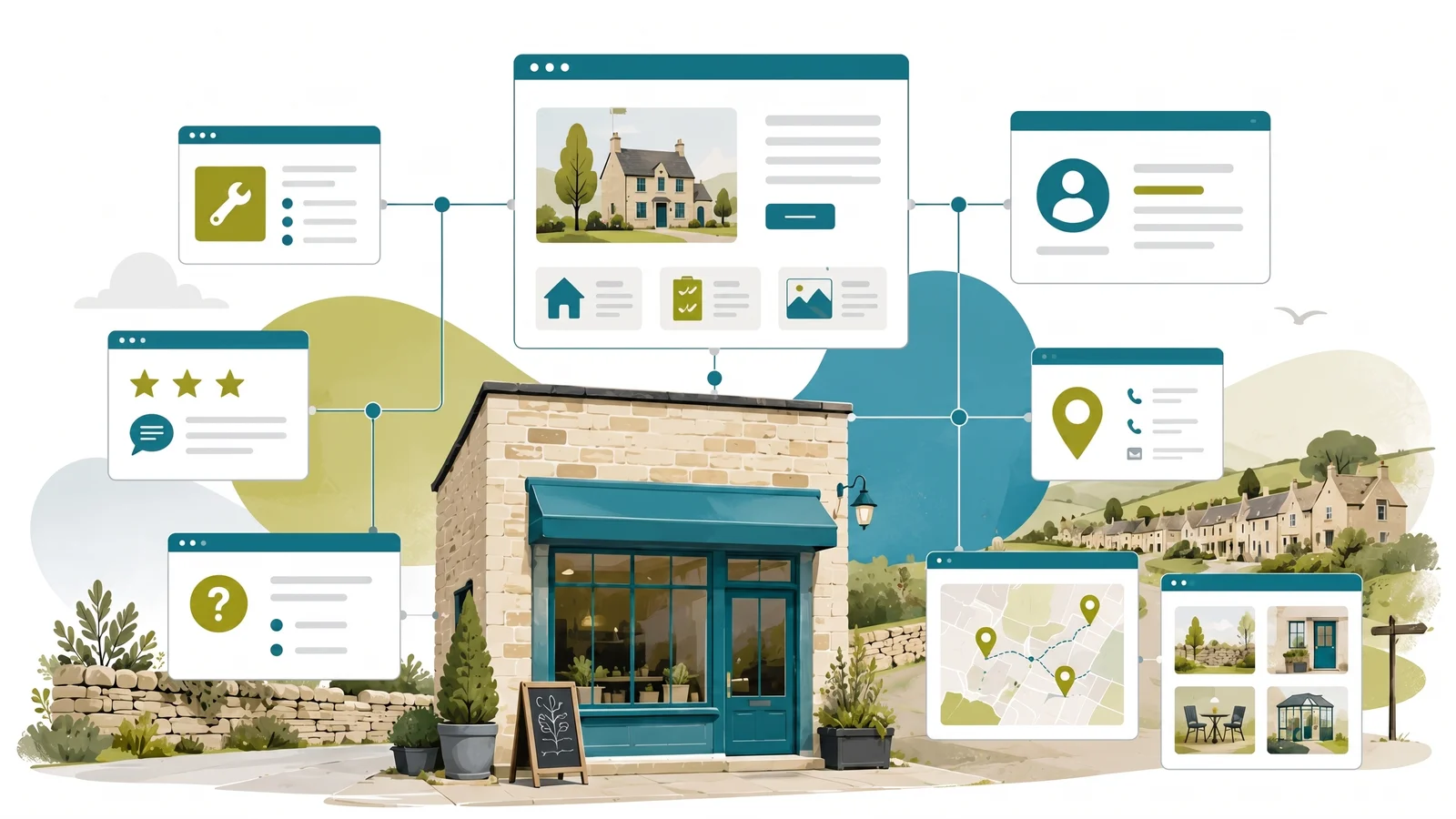
The term gets used loosely, so it is worth being specific. For a small business website, maintenance should cover:
Hosting and domain renewal. Your site needs somewhere to live and your domain needs renewing, usually annually. A lapsed domain renewal is one of the fastest ways to take your business offline entirely, and reclaiming a domain after it expires can be expensive or impossible.
SSL certificate renewal. This is the padlock in the address bar. Certificates expire on a schedule, and when one lapses every major browser shows visitors a full-page security warning before they can reach your site. Most people turn back at that point.
Software and security updates. If your site runs on WordPress or a similar platform, the core software, the theme and every plugin need regular updating. The overwhelming majority of hacked small business websites were running out-of-date software with a known, already-patched vulnerability.
Backups. Regular, tested, off-site backups. A backup you have never restored from is a guess, not a safety net.
Uptime monitoring. Knowing your site has gone down before a customer tells you. Sites go offline for all sorts of mundane reasons, and the damage is proportional to how long it takes anyone to notice.
Broken links and forms. Contact forms fail silently more often than people realise, particularly after a hosting change or an email provider update. A form that stops delivering does not throw an error. It just quietly stops sending you enquiries.
Content changes. Prices change, services change, opening hours change, staff come and go. A site describing a business you were two years ago is actively working against you.

What actually goes wrong when a site is left alone
These are the failures I see most often, roughly in order of how common they are.
The contact form stops working
This is the most damaging failure because it is completely invisible. The form still appears to submit. The visitor sees a success message. The enquiry goes nowhere. Businesses can go months wondering why the website has gone quiet, when in fact it has been generating enquiries the whole time that never arrived.
The SSL certificate expires
Browsers do not handle this gently. Chrome and Safari show a full-page red warning telling visitors the site is not secure and asking whether they really want to continue. Almost nobody continues. Your site is effectively offline until it is fixed.
The site gets compromised
Out-of-date software is the single biggest cause. The attacker is rarely targeting you specifically. Automated tools scan for known vulnerabilities at scale, and an unpatched site is found eventually. The results range from injected spam links that destroy your search rankings to the site being taken over entirely.
Recovering from this is genuinely expensive. Cleaning a compromised site, restoring from a clean backup, and asking Google to remove a security warning from your listing costs considerably more than years of maintenance would have.
The content goes stale
Less dramatic, but it steadily costs you work. Old prices create awkward conversations. Services you no longer offer generate enquiries you have to turn away. Services you added last year bring in nothing because they are not on the site. Opening hours that changed at Christmas and never got updated send people to a closed door.
Performance degrades
Sites get slower over time as images accumulate and plugins pile up. Page speed affects both your search rankings and whether visitors stay, and the decline is gradual enough that you acclimatise to it without noticing.
Why you are the last person to see any of this
This is the part worth dwelling on, because it explains why these problems run for so long.
You visit your own website differently from everyone else. Your browser has it cached. You are often logged in. You go straight to the pages you know, on the device you always use, on your home or office wi-fi. You are not filling in your own contact form, and you are not arriving cold from a Google search on a phone with patchy signal.
Every one of the failures above is most visible to a first-time visitor on mobile, and least visible to you. By the time a problem is obvious from where you are sitting, it has usually been costing you enquiries for a while.
What maintenance should cost
Prices vary, but for a small business website here is roughly what the market looks like:
DIY platforms (Wix, Squarespace): £12 to £25 per month. The platform handles security and hosting for you, which is a genuine advantage. But content updates, broken forms and stale copy are still entirely your responsibility, and that is where most of the real work sits.
Independent maintenance plans: £20 to £50 per month for a straightforward local business site, usually including hosting. This is the range most small businesses should expect.
Agency retainers: £50 to £200 per month and up. Often justified for larger or more complex sites, frequently more than a local service business needs.
Nothing at all: free until something breaks, then typically £300 to £1,000+ to recover a compromised or broken site, plus whatever the downtime cost you in lost enquiries.
Our own maintenance is £29 per month, which covers hosting, your domain, the SSL certificate, security and software updates, backups, uptime monitoring, and minor content changes such as new services, updated contact details or fresh testimonials. Larger developments and new features are quoted separately and agreed with you before any work begins.
What to ask before you pay for it
If you are considering a maintenance plan, from us or anyone else, these are the questions worth asking:
- Is hosting included, or billed separately? This is the most common source of surprise costs.
- Who owns the domain? It should be you. Ask directly, and get the answer in writing.
- How often are backups taken, and where are they stored? Off-site and automated, ideally daily.
- What counts as a content change, and what is billed extra? A clear line here avoids awkward conversations later.
- How do I request a change, and what is the turnaround? A named contact beats a ticket queue for a small business.
- What happens if I leave? You should be able to take your content and your domain with you.
If a provider is vague on any of these, particularly domain ownership, treat that as the answer. This is one of the main reasons local businesses end up leaving providers like Yell: they discover too late that they were renting rather than owning.
The honest summary
Website maintenance is not exciting and it is not something you will notice working. That is precisely the point. A maintained website is one you do not have to think about.
The businesses that get burned are not the ones who chose the wrong provider. They are the ones who assumed a website was a one-off purchase, left it alone for three years, and then discovered that the contact form had been broken for eight months, or that the site had been quietly serving spam links to Google since the spring.
We look after websites for local businesses across Bristol, London, Manchester and the rest of the UK.
For most local businesses, maintenance costs less per month than a single lost enquiry. If you are weighing up whether it is worth it, that is usually the comparison that settles it.
Want your website looked after properly?
We build websites for local businesses and maintain them ongoing. Hosting, security updates, backups and content changes all included. From £795 one-off build + £29/mo hosting, maintenance and security.
Tell us about your business